Diagnostic field note
The hygiene cycle was necessary. Its timing was not.
On four Sundays, the controller-identified hot-water hygiene event occurred after solar production had fallen and shortly before cheaper electricity began. This page documents the pattern, not a completed savings trial.
What we learned
Keep the programme. Improve only its supported start window.
The heat pump followed a valid local schedule. The schedule did not know about household PV, the coming tariff window, battery reserve or other large loads.
A whole-home controller can select a better eligible time, but it must not redefine the health requirement or treat a failed cycle as an energy saving.
Safety note
Do not disable or weaken a domestic hot-water hygiene programme.
Any timing change must use a documented control supported by the manufacturer and installer. Target temperature, hold time, recurrence, heater permissions and anti-scald protection must remain unchanged unless a competent professional changes the approved system design. The cycle must still report successful completion. This is an energy-management field note, not plumbing, public-health or Legionella-remediation advice.
Four Sundays
The same blind spot appeared four times.
Each chart is from the first GridPassport home admin panel. Open an image to inspect the full annotation.
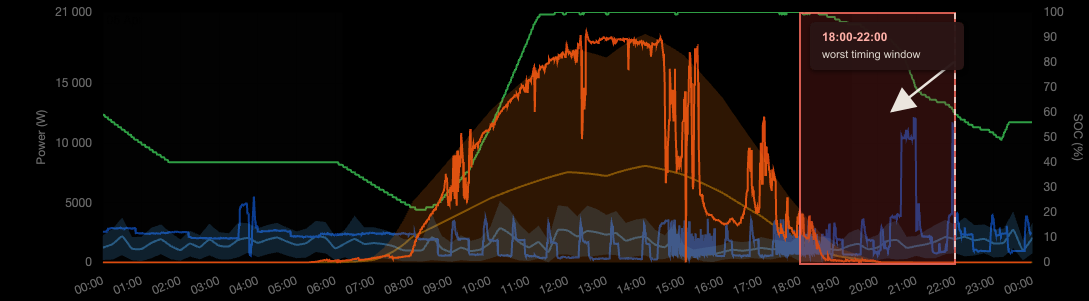
The identified hygiene event coincided with a large household power peak after PV had fallen away and before the cheaper tariff window.
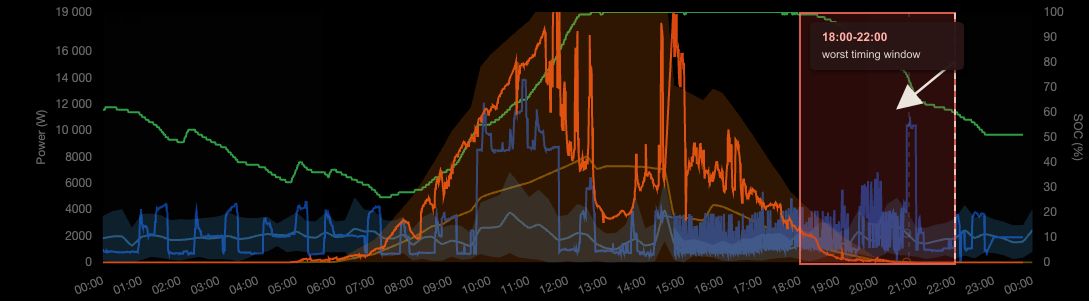
Useful solar hours had occurred earlier. The fixed weekly schedule still placed the event in the evening import period.
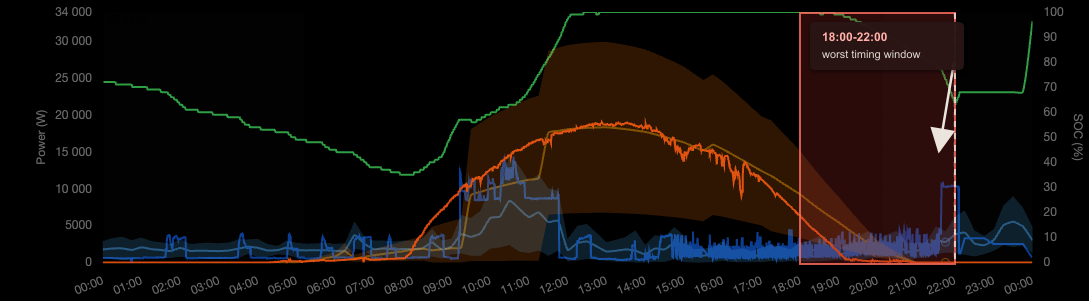
The schedule knew the weekday and start time. It did not use the earlier PV window when selecting the event timing.
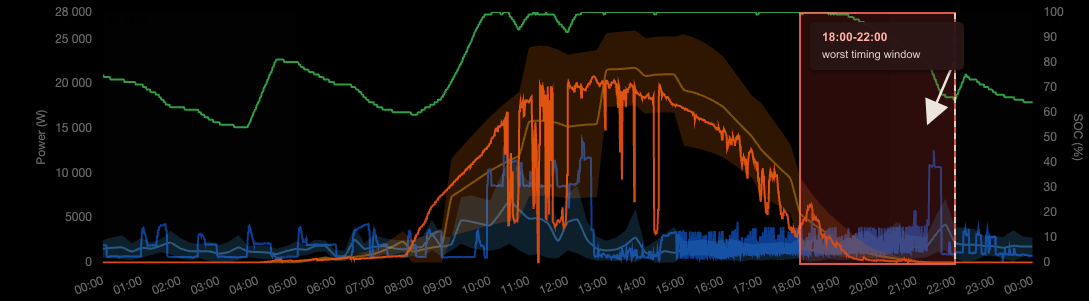
The heat-pump controller followed its own schedule while the household paid import cost across every device together.
Evidence boundary
What the charts show, and what they do not.
ObservedTimestamp, PV profile and whole-home power around the controller-identified event.
InterpretedThe fixed timing missed earlier solar and ran before the cheaper tariff window.
Not isolatedDevice-only energy, immersion-heater share and the exact event cost.
Not yet provenSavings after moving the event to a different eligible time.
Why kW is not kWh
A power peak cannot be priced without its duration.
The 5 April chart rose above 10 kW at whole-home level. That is power at a moment, not 10 kWh of energy. Energy requires the area under the power curve, and attributing it to the hygiene event requires a device meter or reliable device telemetry.
A defensible cost study would calculate device energy from interval power, incremental grid import from the home meter and the opportunity cost of PV that could otherwise have been exported.
device energy = sum(device power x interval duration)
grid cost = sum(incremental import x import tariff)
PV opportunity cost = sum(PV diverted from export x export tariff)
Safe timing hierarchy
A cheaper hour is useful only if the programme still completes.
- 1
Preserve every manufacturer and installer safety parameter.
- 2
Choose an eligible window long enough for confirmed completion.
- 3
Avoid expected heavy hot-water draw where the equipment instructions require it.
- 4
Among safe windows, prefer useful PV, a lower tariff or favorable outdoor conditions.
- 5
Check conflicts with space heating, battery reserve and whole-home power limits.
- 6
If completion is not confirmed, restore the manufacturer schedule and raise an error.
Next evidence
What a real before-and-after result still needs.
- Several comparable cycles before and after the timing change.
- Confirmed start, target, hold period and successful completion.
- Tank temperature and hot-water draws during each cycle.
- Heat-pump and immersion-heater energy measured separately where possible.
- PV, battery, grid import, export and interval tariff data.
- Comparable starting water temperature and outdoor conditions.
Until those data exist, the honest conclusion is narrower: the home repeatedly ran a necessary programme in a poor whole-home energy window.
FAQ
Hygiene-cycle timing questions.
Should a heat-pump hygiene cycle be disabled to save energy?
No. This field note does not recommend disabling, weakening or skipping a domestic hot-water hygiene programme. Health and manufacturer requirements take priority.
What can energy management change safely?
Only a supported timing control, and only within manufacturer and installer rules. Target temperature, hold time, recurrence, heater permissions and anti-scald protection must remain governed by the approved system configuration.
Why not say the event used 10 kWh?
Because the chart shows power in kW, not energy in kWh. Device energy requires power integrated over time and ideally a device-specific measurement.
Is midday always the best time?
No. A safe eligible window may follow solar, a cheap tariff, outdoor temperature or household hot-water use. Reliable completion of the programme comes first.
Did this field note prove a saving?
No. It documents four repeated timing conflicts. A savings claim requires comparable before-and-after cycles with device energy, import, export, tariff and completion data.
Sources
Public-health and equipment references.
- World Health Organization: Legionellosis
Public-health context for Legionella growth, water-system risk and transmission through contaminated aerosols.
- UK HSE HSG274 Part 2: hot and cold water systems
Authoritative guidance on temperature, stagnation, thermal disinfection, scalding risk and water-system controls.
- Energy Saving Trust: electrical guidance for heat pumps
Notes that a hygiene cycle may use an immersion heater and that timing and manufacturer requirements belong in system commissioning.
- Mitsubishi Ecodan FTC4 databook
A manufacturer example showing configurable time, frequency, target temperature and hold period under installer responsibility.
- UK government: hot-water cylinders, buffer tanks and heat pumps
Laboratory research on heat-pump cylinder performance, sterilisation cycles and timing when hot-water draw is low.