Dated, weather-based
Tomorrow's forecast
Tomorrow's value is a weather-based estimate for Tuesday, September 1, 2026: 51.7 kWh from the 10 kWp reference system, with a likely range of 45.2 kWh–57.9 kWh. It changes with the next weather forecast.
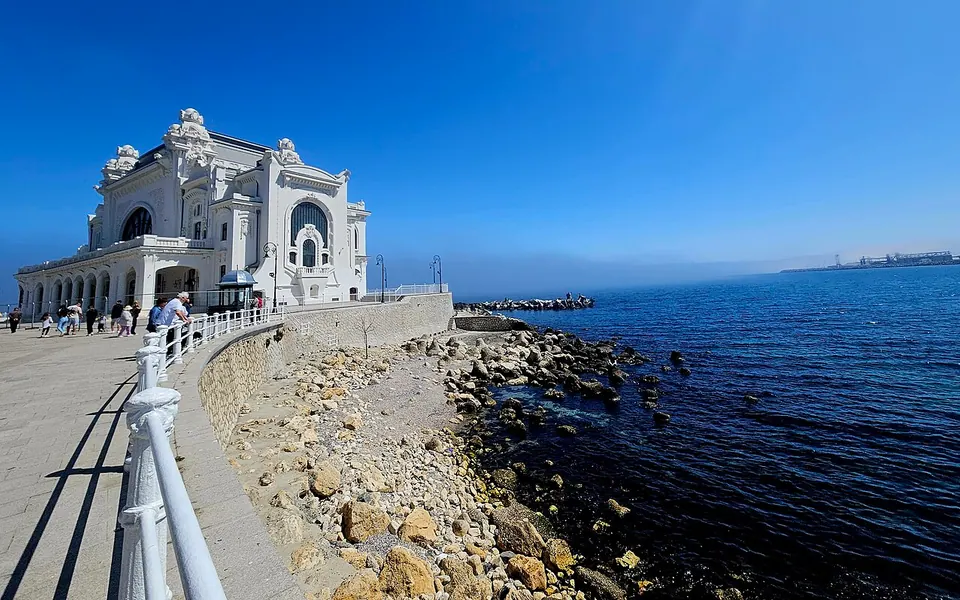
Romania · 10 kWp reference system
Photo: Andymxm,CC BY 4.0. Cropped, resized and converted to WebP by GridPassport.
Forecast target: . Any “tomorrow” label on this page refers to this dated target.
Tuesday, September 1, 2026
For a standard 10 kWp south-facing system in Constanța, GridPassport estimates 51.7 kWh on Tuesday, September 1, 2026, with a likely range of 45.2-57.9 kWh. The strongest production window is expected at 12:00-16:00 local time.
Updated Aug 31, 2026, 02:01 AM GMT+3 · fresh snapshotHow to read and use the data
The daily and annual figures answer different questions. Use the dated forecast to plan tomorrow, and the PVGIS specific yield to compare locations or estimate a typical year.
Dated, weather-based
Tomorrow's value is a weather-based estimate for Tuesday, September 1, 2026: 51.7 kWh from the 10 kWp reference system, with a likely range of 45.2 kWh–57.9 kWh. It changes with the next weather forecast.
Multi-year climate baseline
Constanța's PVGIS specific yield is about 1,318 kWh/kWp per year. It is a multi-year climate benchmark, not a prediction for tomorrow or for this calendar year. In the PVGIS profile, August is typically the strongest month and December the weakest.
3, 5 and 10 kWp reference systems
Linear reference scaling only: south-facing, 35° tilt and 14% system losses. It does not resize inverter clipping, shade or local roof constraints.
From forecast to a household plan
Treat the forecast as a gross solar-energy budget before household base load and conversion losses. The numbers support scheduling; they do not guarantee surplus.
Battery
Use 12:00-16:00 as the first candidate charging window. Battery state of charge, reserve settings and inverter limits still decide how much can be stored.
EV
The scaled 5 kWp estimate is 25.9 kWh before household use. Compare the remainder after base load with the planned EV charge and stagger charging if needed.
Heat pump
If comfort controls allow it, place discretionary hot-water heating or pre-heating inside 12:00-16:00. Never override frost protection, hygiene cycles or manufacturer limits.
Large loads
A 3 kWp system scales to about 15.5 kWh for the day before household use. Run flexible loads sequentially during the strongest hours rather than assuming all forecast energy is simultaneous power.
Local questions
Using the same south-facing, 35-degree and 14% loss assumptions, the 5 kWp estimate is 25.9 kWh for Tuesday, September 1, 2026, with a scaled likely range of 22.6 kWh–28.9 kWh. This is a linear reference-system estimate, not a site survey.
It means the PVGIS multi-year profile produces about 1,318 kWh in a typical year for each installed kWp under the reference assumptions. A 5 kWp system therefore scales to about 6,590 kWh in a typical year before site-specific adjustments.
No. Tomorrow's forecast uses dated weather and an uncertainty band for one day. The PVGIS figure is a multi-year climate-based specific yield used for typical monthly and annual comparisons.
Start with 12:00-16:00, then check household base load, battery headroom, EV energy required and heat-pump safety or comfort constraints. The forecast estimates daily energy, not guaranteed instantaneous surplus.
Typical year
A standard 10 kWp system produces about 13,180 kWh in a typical year at this location. Monthly averages show seasonality; they are not a forecast for a specific year.
Values are kWh per month. Source: European Commission JRC PVGIS.
What makes Constanța's solar profile different?The typical annual yield is about 1,318 kWh per installed kWp, ranking Constanța #1 of 6 modelled locations in Romania. That is 7% above the median of the 6 Romania locations in this dataset. August is typically the strongest month and December the weakest; the stronger month produces about 2.9 times as much.
Nearby solar forecasts
Tomorrow, in one email
Tomorrow's expected production, likely range and strongest hours. One useful email each day.
Every city uses a 10 kWp system facing south at 35 degrees with 14% system losses. Tomorrow's figure combines hourly weather with GridPassport's PV production and uncertainty model. The monthly profile uses the European Commission JRC PVGIS multi-year climate series. Roof direction, shade, snow, dirt, inverter clipping and local weather can change real output.
CSV and JSON snapshots are published under CC BY 4.0 with source attribution.